Default volume does not rise evenly across the country. It concentrates: a court backlog in one state, a new mediation requirement in another, a plant closure or a hurricane in a third. When that happens, multi-state default servicing coverage stops being a procurement line item and becomes an operating problem, because the states creating the pressure are rarely the states where your referral relationships are deepest.
Volume Moves State by State
Two servicers with similar portfolios can have very different default experiences depending on where their loans sit. Judicial states behave differently from non-judicial states. Statutory timelines, local court calendars, mediation and conciliation programs, and state-specific loss mitigation requirements all pull in different directions at different times.
That variation means a portfolio does not get harder all at once. It gets harder in three or four states while the rest stay flat.
What a Firm Handoff Actually Costs
The instinct when volume spikes in a new state is to add a firm there. That solves the coverage gap and creates a different set of costs, most of which land on your team rather than the new firm’s.
None of that is unusual. It is just slow, and it tends to arrive at the exact moment your timelines are already under strain.
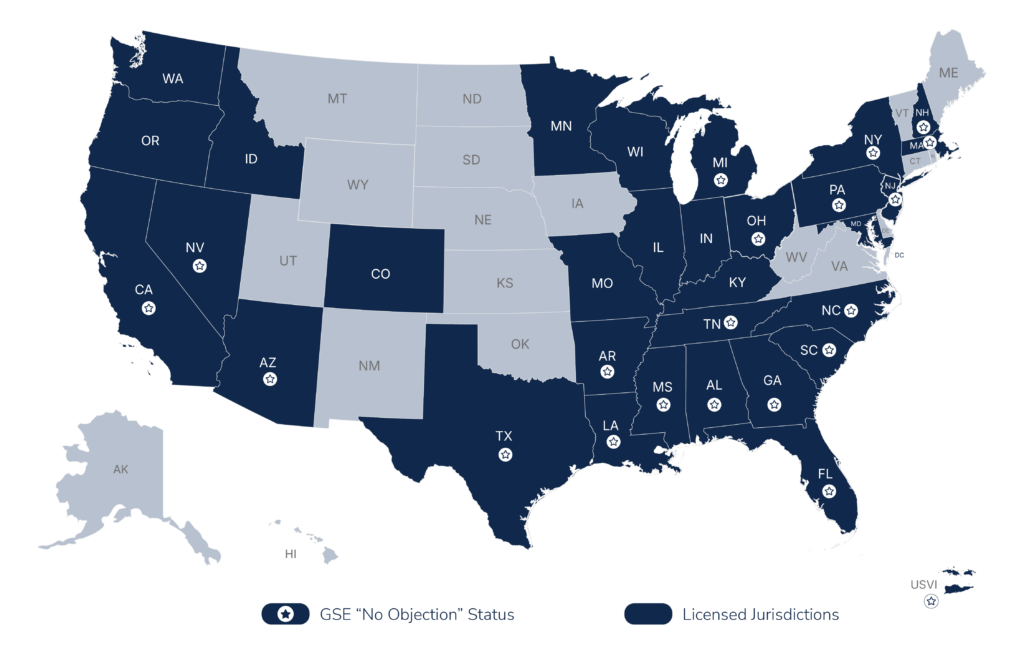
Coverage in 21 Jurisdictions with GSE No Objection Status
ALAW maintains an active default legal servicing practice across 21 jurisdictions with GSE “No
Objection” status, supported by a broader licensed footprint spanning 33 jurisdictions. This
allows us to deliver consistent execution, local compliance, and centralized oversight. The practical effect is that when your volume moves into a state we already cover, the work moves with it. There is no new firm to vet, no separate onboarding cycle, and no ambiguity about who owns the answer when a timeline gets tight.
That is the case for consolidating multi-state default servicing coverage rather than assembling it state by state after the fact. Fewer firm handoffs means fewer integration projects, fewer reporting formats to reconcile, and a single point of accountability across the footprint. It does not make hard states easy. It does mean the operational overhead of expanding into them is largely already absorbed.
Consolidation is also easier to defend internally. Oversight obligations do not shrink when a network grows, and every additional firm is another set of controls to monitor, another audit trail to maintain, and another party to bring current on your requirements.
Bring Us the States Giving You the Most Trouble
We’ll be at the Five Star Conference and Expo, September 1 to 3, at the Omni Dallas. The most useful conversation is a specific one. Come with the two or three states where your timelines are slipping, or your volume is climbing, and we will tell you what we are seeing in those jurisdictions right now. If the answer is that another approach fits better, we’ll say so.
If your footprint is shifting and your multi-state default servicing coverage has not caught up, Dallas is a good place to start the conversation. Reach us at [email protected] or alaw.net.